
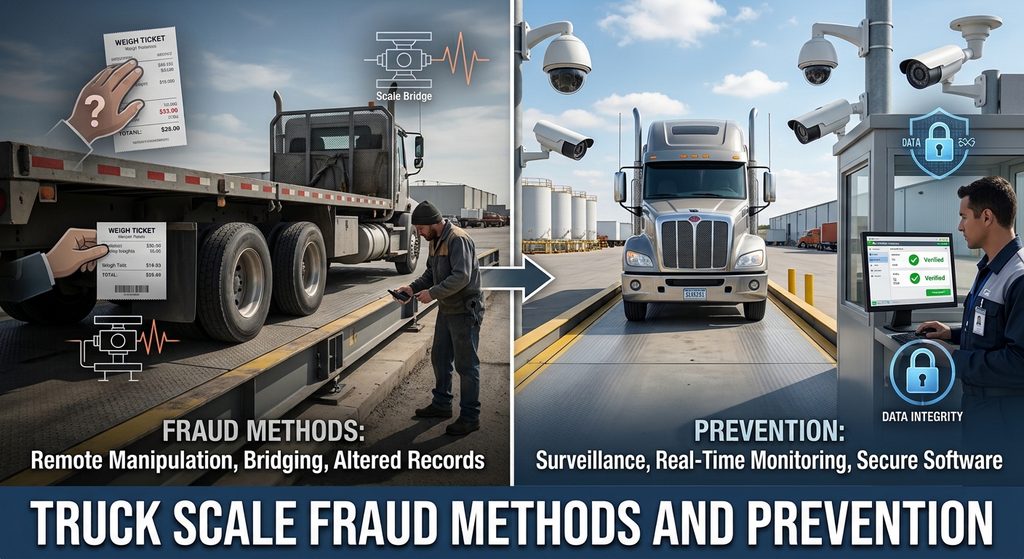
A scale is like the heart of an organization—much of a company’s profit and loss depends on it. In Bangladesh, Truck Scale Fraud or manipulating material weight (making low or high) is a common, everyday occurrence. How truck drivers short-deliver material to a factory or take out extra material, or how suppliers deliver less—these things are not discussed much in our country, but if we want, we can prevent them and save factory owners, shareholders, and customers from massive losses. In the scale sector, with 16 years of experience at Nexpro Limited, we have seen how these thefts are carried out. Today we will discuss the methods of theft and their prevention.
- Not positioning the vehicle correctly: The entire body of a truck must be on the scale. What truck drivers do here is leave part of the front wheels or rear wheels off the scale. Even if it is as little as one inch, the weight can read 100 to 500 kg less. That means the driver took more material out of the factory, but no one noticed. Many times this is done in collusion with the scale operator.
Prevention: To prevent this, positioning sensors can be installed on both sides of the scale. If the truck is not positioned correctly, the weight will not register in the scale software and the software will not operate. Nexpro Limited has a solution for this, and we have implemented remedies in various locations. - Increasing the empty vehicle’s weight: What is done here is that when an empty truck enters the factory, its weight is increased by keeping bags of sand, bricks, or buckets of water or various materials on it. That is, the tare weight increases; after loading the material, the bags of bricks and sand or whatever was loaded before the tare weighing are discarded, so the net weight reads lower. In this case, 50 to 300 kg of product can leave the factory without anyone catching it.
Prevention: Maintaining a tare weight database for each vehicle so that if the tare increases or decreases for any reason, it can be tracked. If there is any suspicion, it should be physically checked. Nexpro Limited supplies software to prevent this type of theft. - Load cell cable tampering or remote control: This is a highly technical and sophisticated method. Criminals install a small remote device in the signal cable between the load cell and the indicator, or inside the junction box. Weight can be increased or decreased via the remote. Since there is no way to see or understand this from the outside, it is very difficult to detect.
Prevention: Use digital load cells with encrypted communication protocols (which are much harder to hack or have their signal intercepted), protect exposed signal cables with stainless steel conduit, and regularly inspect junction boxes and wiring for any unauthorized devices. Nexpro Limited always advises its clients to use digital load cells. Nexpro Limited has high-quality digital load cells that cannot be tampered with. - Scale indicator tampering or setting a stepped load: This is a highly technical and sophisticated method. Suppose you know your empty truck’s weight. After putting the empty truck on the scale, you see the empty truck’s weight is correct, but when you weigh the loaded truck, you find the weight has gone off. What is done here is that different weights are set in different capacity seats (calibration points) of the scale. Generally, an empty vehicle is 5 to 8 tons, and up to that point the weight stays correct, but once it goes above 10 tons, you see that for every ton, the weight is off by 20 kg, 30 kg, or 100 kg.
Prevention: It is advised to use indicators that do not have provisions for indicator tampering; in that case, we recommend using Minebea or Flintec indicators. - Ghost weighing and double-stepping: What is done here is that a truck is weighed under one registration plate, partially unloaded or loaded, the plate is changed (or a second vehicle is used), and it is weighed again to falsify the material delivered.
Prevention: In this case, Nexpro Limited advises its respected customers to use software with an Automatic Number Plate Recognition (ANPR) system and software with the facility to print images of the front and rear of the truck on the scale slip through live image capturing. Currently, Nexpro Limited is supplying software to prevent ghost weighing and double-stepping. - Manipulation through the scale software: Generally, the weight comes directly from the scale to the scale software, and that weight is accepted and the weight slip is printed. But what is done here is that the truck’s weight is manually entered by hand, so the operator can make the vehicle’s weight lower or higher if they wish.
Prevention: To prevent this, we advise using server-based software with a highly secure login system and administration management, so that weight cannot be entered manually in any way. Nexpro Limited supplies server-based software to its respected clients. - Uneven weight at the front and rear of the scale: If a scale has one weight at the front and another at the rear, drivers notice where the weight reads lower or higher and position the truck at that spot.
Prevention: To prevent this, the weight at the front, rear, and middle of the scale must be kept equal—the corner load of each load cell must be adjusted. Nexpro Limited provides service through regular servicing and maintenance.